How Film Weight Affects Pour Quality and Panel Life
Film weight is the specification line buyers skip, and it is the one that decides how many pours a panel survives. The manufacturer publishes two weights — 165 g/㎡ on smooth surfaces and 130 g/㎡ — and quotes high-grade panels at 10–20 reuse cycles in concrete pouring, against roughly 3–5 cycles for an economical melamine-bonded black film panel.
Key takeaways
- Two film weights are published: 165 g/㎡ on smooth surfaces and 130 g/㎡ as the second option.
- High-grade panels are quoted at 10–20 reuse cycles; an economical black film panel with melamine bonding is quoted at 3–5.
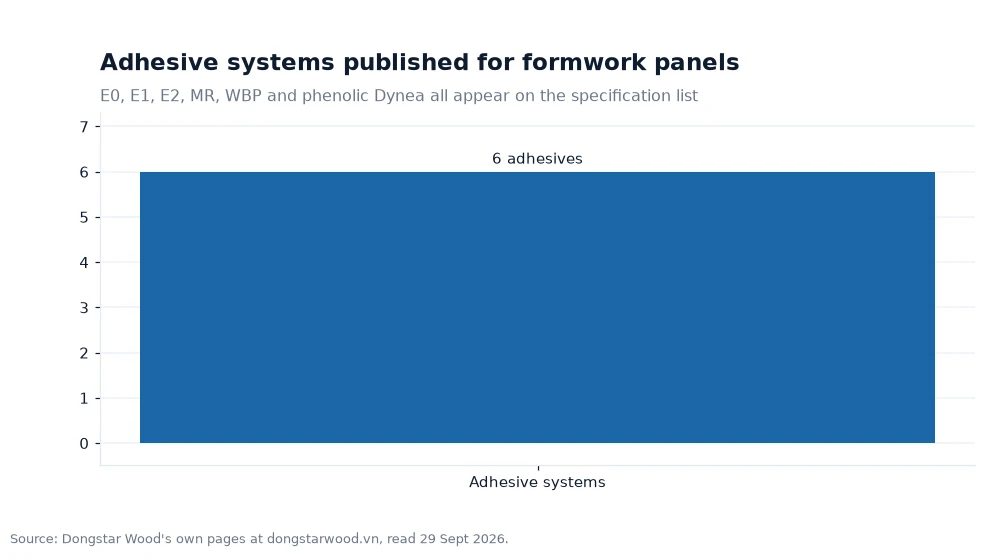
- Six adhesive systems are listed, from E0, E1 and E2 through MR and WBP to Phenolic Dynea.
- Six core builds are offered, including Acacia, Eucalyptus, White Hardwood and a Combi hybrid.
What film weight actually measures
The film is the surface the concrete touches. It is a resin-impregnated paper pressed onto the face veneer, and its weight per square metre describes how much of that resin sits between the panel and the pour. A heavier film covers the veneer more completely, which matters because the film wears first: every strike, every clean-down and every abrasive brush takes a little of it away. The range is sold as Film Faced Plywood — also called formwork plywood in the client's own wording — and the film is its working face.
That is why film weight is quoted on the specification rather than buried in a data sheet. Two panels can be identical in thickness, core and glue and still behave differently on site if one carries more film across its surface. On a single pour nobody notices. By the eighth pour, one panel is still flat and sealing against the next, and the other is showing veneer through the face.
| Film option | Published description | Where it is aimed |
|---|---|---|
| 165 g/㎡ | Filmed on smooth surfaces | The heavier of the two published weights |
| 130 g/㎡ | Second published film weight | Economical panels and lighter shuttering duty |
| Dark brown film | One of three films offered | Standard concrete contact faces |
| Black film | Offered across the formwork range | Contact faces where cost drives the choice |
| Anti-slip film | Textured, sold as wire mesh film faced panels | Walking routes and access decks |
Two weights, and the arithmetic that separates them
The published split is simple: 165 g/㎡, filmed on smooth surfaces, and 130 g/㎡. Neither is presented as the correct answer — they are two positions on a cost and life curve. A site pouring the same wall repeatedly wants the heavier face, because the film is what limits reuse. A site pouring a one-off foundation or a small slab wants panels that do the job once and leave money in the project.
The phenolic film surface also has to survive concrete chemistry. Fresh concrete is alkaline, and a filmed face with sealed edges resists that attack far better than bare veneer. Panels are offered in the 1250 × 2500 mm, 1500 × 3000 mm, plus 1220 × 2440 mm formats, with custom sizes up to 1830 × 3830 mm, so a pour can be planned around a sheet size that reduces cutting and leaves fewer unsealed edges on the deck.
Six core builds, and why the core decides the cycles
Film and glue set the surface; the core decides whether the panel still sits flat after ten pours. Six options are listed: Birch, Eucalyptus, Acacia, White Hardwood, Rubber and Combi. The published notes are worth reading closely — Acacia Core is described as a high-strength hardwood alongside excellent density and superior load-bearing capacity, Eucalyptus Core on maximum strength and compression resistance, White Hardwood (species such as Bodhi) on stability and balanced mechanical strength, and Combi Core as a Eucalyptus and Acacia hybrid that balances strength, weight and cost.
Adhesive systems run in parallel: E0, E1, E2, MR, WBP and Phenolic Dynea, six in total. For repeated pours with wet concrete against the face, the phenolic and WBP end of that list is where most specifications land, because the glue line is the second failure point after the film. A panel with a heavy film and a soft glue still delaminates at the edges.
Ordering has a practical side too. Panels are specified by format, thickness, core, glue class and film weight, and a shuttering schedule that names all five can be priced without a site visit. Leave any one of them open and you end up with two quotations that look different for reasons nobody can explain afterwards.
Worked example: contact area from one sheet of shuttering
Take a 1250 × 2500 mm panel: 1.25 m × 2.50 m → 3.125 m² per sheet. If the panel is booked for 15 pours, one sheet delivers 3.125 × 15 = 46.875 m² of concrete contact area over its life. A 6,000 m² slab programme therefore needs 6,000 ÷ 46.875 = 128 sheets, before any edge damage is written off.
Run the same sum at 10 pours instead of 15 and the picture changes quickly: 3.125 × 10 = 31.25 m² per sheet, so 6,000 ÷ 31.25 = 192 sheets. The gap between 128 and 192 sheets — 64 panels — is the entire commercial argument for film weight, sealed edges and clean-down discipline between pours.
Edges, cleaning and the cycles that quietly disappear
Most of the reuse a site loses is lost at the edge. An unsealed edge wicks water into the core, swells the veneers and lifts the film from the inside; once that starts, the panel is finished regardless of how heavy the film is. Sealed edges and a clean stack, with stickers between panels so air moves, protect more cycles than any upgrade to the face.
Clean-down matters for the same reason. Concrete residue left on a filmed face is scraped off before the next pour, and the scraper takes film with it. Water and a soft brush, worked along the grain rather than across it, keeps the surface intact — and keeps the difference between a panel that reaches its quoted cycles and one that reaches half of them.
Frequently asked questions
Does film weight change the finish of the concrete?
It changes how long the finish stays consistent. The film is the surface the concrete contacts, and the published options are dark brown, black and anti-slip textured film, with 165 g/㎡ quoted on smooth surfaces. A heavier, intact film keeps a uniform contact face pour after pour; once film wears through to the veneer, the finish marks.
How many pours should a film faced panel be booked for?
Book the panel for the cycle count its specification supports. The published figure for high-grade panels is 10–20 cycles, and the melamine-bonded black film option is quoted at about 3–5. What moves a panel between those two numbers is film weight, core density and glue class, along with how carefully edges are sealed and faces cleaned between pours.
Which adhesive system suits repeated pours?
Six systems are published — E0, E1, E2, MR, WBP and Phenolic Dynea. Where panels meet wet concrete and are cleaned for reuse, the WBP and phenolic options are the usual choice, since the glue line is what holds the film and face veneer together after the edges have taken water.
Where to take the specification next
Two neighbouring pages answer the questions a film faced order usually raises. If the programme is cost-driven, the ordinary black film faced option sets out the melamine-bonded panels quoted at 3–5 cycles. If people will walk or kneel on the panels, the textured grip-surface panels describe the hexagonal anti-slip face and the thickness range offered for access work.
Specification lines were verified on 29 Sept 2026, drawn from the manufacturer's own website[1].