How Can a Period Underwear Manufacturer Help Build Your Product Line?
A period underwear manufacturer can support a brand from fabric selection and absorbent-layer design to sizing, wash testing, packaging, and repeat production. A commercial style may combine 3–5 functional layers, use 10–40+ mL internal absorbency targets, and require separate fit checks across several sizes. Material shrinkage of even 3–5% can change gusset position or waistband fit after washing. Manufacturers can also reduce development work by using one tested construction across briefs, hipsters, boyshorts, and overnight styles. For a brand building 20–50 SKUs, shared fabrics, standardized components, and documented QC tolerances can keep production more consistent.
Developing period underwear starts with translating a product idea into measurements a factory can reproduce. “Heavy absorbency” alone is not a manufacturing specification. The brief should define fabric composition, GSM, finished measurements, gusset dimensions, target liquid capacity, layer sequence, stitching method, elastic width, labels, packaging, and size tolerances. A 2026 product line with five sizes, three colors, and three absorbency levels already creates 45 SKU combinations before adding another silhouette.
That SKU count is why manufacturers usually recommend building the range around a smaller number of repeatable constructions. One moderate-flow gusset can sometimes be used across a bikini, high-rise brief, and hipster while the outer pattern changes. A second construction can cover heavier flow by extending the absorbent section toward the rear and adding material capacity. Keeping two or three functional structures instead of creating a new one for every style reduces the number of materials, cutting instructions, inspection points, and production setups.
A useful development question is not “How absorbent can the underwear be?” but “How much absorbency is needed without making the garment too thick, slow to dry, or difficult to wash?”
That question leads directly to material engineering. Period underwear commonly uses several layers with different jobs: a skin-contact layer for moisture transfer, an absorbent textile, a leak-resistant membrane, and the outer body fabric. Some constructions use 3 layers, while others use 4 or 5 depending on capacity and hand feel. Adding 20% more absorbent material does not automatically produce a 20% better garment because liquid distribution, stitching, pressure, and usable gusset area also affect performance.
Fabric selection therefore needs to be evaluated as a system rather than by softness alone. Cotton-rich fabrics can provide a familiar hand feel, while nylon-elastane or polyester-elastane knits may offer faster drying and stronger stretch recovery. Modal and viscose blends are also widely used in underwear. A manufacturer should compare GSM, stretch percentage, recovery, shrinkage, pilling, colorfastness, and washing behavior before approving bulk fabric.
| Product area | Typical development variables | Why the manufacturer checks them |
|---|---|---|
| Body fabric | GSM, stretch, recovery, shrinkage | Controls fit after repeated washing |
| Top layer | Wicking speed, softness, surface dryness | Affects skin contact and moisture movement |
| Absorbent section | Thickness, area, liquid capacity | Determines usable protection |
| Barrier layer | Coverage, flexibility, wash stability | Helps reduce leakage |
| Elastic | Width, elongation, recovery | Controls waist and leg fit |
| Gusset | Length, width, position | Controls protection coverage |
Shrinkage deserves particular attention because a 4% change in a 250 mm section equals 10 mm. That difference is large enough to alter how an absorbent panel sits against the body. Manufacturers normally compare fabric dimensions before and after defined wash cycles, then adjust pattern allowances or reject combinations that move differently from one another.
Once the fabrics are selected, sampling shows whether the design works on a person rather than only on a specification sheet. One style may pass through an initial prototype, fit sample, revised sample, size set, and pre-production sample. If five sizes are planned, checking only the medium size leaves grading problems undiscovered. Waist rise, leg opening, crotch width, back coverage, and gusset position all change as a pattern moves from XS to XXL.
Sizing also affects functional coverage. Increasing hip circumference by 10% does not mean the absorbent section should automatically increase by exactly 10%. Larger sizes may need wider gusset coverage, different elastic tension, or adjusted front-to-back placement. Manufacturers with underwear pattern experience can grade the garment and the protection zone separately, then confirm both during fitting.
Fit approval should then be connected to performance testing. There is no single universal absorbency number that makes every product “light,” “moderate,” or “heavy,” so brands often establish their own measurable categories and use the same test method across the collection. A line might, for example, set internal targets at 10 mL, 20 mL, and 35 mL, provided the claims accurately reflect the method used and are supported by test records.
Performance checks can include:
-
total liquid capacity and absorption speed;
-
rewet after pressure is applied;
-
leakage around seams and panel edges;
-
dimensional change after 5, 10, or more wash cycles;
-
waistband and leg elastic recovery;
-
colorfastness and pilling;
-
seam strength and delamination checks.
Using the same procedure matters more than choosing an impressive number. If one sample is tested with 10 mL poured slowly and another with 30 mL delivered rapidly, the results are not directly comparable. A manufacturer should document the liquid type, volume, application rate, waiting period, pressure, sample condition, and number of tested pieces so that later production batches can be checked against the same method.
Repeated washing is especially important because reusable underwear is sold for continued use rather than one cycle. A product that looks acceptable after wash 1 may behave differently after wash 20. The body fabric may shrink 3%, the membrane may become less flexible, or elastic recovery may change. Testing several production samples rather than one garment gives a more useful picture of consistency.
That consistency depends on production controls. Period underwear can look correct externally while containing an absorbent panel positioned several millimeters too far forward or backward. Production documents therefore need measurements for the internal construction as well as the visible garment. A factory can set tolerances for gusset length, panel width, seam placement, waistband dimensions, and finished garment measurements, then inspect them during sewing rather than waiting until final packing.
A practical inspection plan may check raw materials on arrival, first pieces from the sewing line, in-line production, finished measurements, appearance, labels, and packaging. If a batch contains 3,000 units, finding an incorrect membrane position after all 3,000 have been sewn is far more expensive than finding it within the first 30 pieces. Early inspection also gives operators a clear reference before production volume increases.
Manufacturers can also help control product cost while specifications are still flexible. Period underwear contains more components than a standard brief, so small design changes accumulate. Extending a gusset by 30 mm increases the use of the top layer, absorbent textile, membrane, thread, and sewing time. Across 10,000 units, even a material increase of only $0.08 per garment adds $800 before freight, duty, warehousing, or retail packaging.
For that reason, cost planning works better when the factory quotes alternative constructions. A brand can compare a 3-layer and 4-layer gusset, standard elastic and custom jacquard elastic, printed packaging and plain recyclable packaging, or a stock fabric and a custom-dyed fabric. The less expensive option is not always preferable, but the comparison shows where each dollar is being added.
MOQ planning becomes equally important as the range grows. A collection with four styles, four colors, six sizes, and two absorbency levels contains 192 possible variants. Producing every combination in the first order can spread inventory too thinly. A manufacturer may instead recommend using two shared fabrics, two gusset constructions, and a limited color palette for the first production run, then expanding after sales data shows which combinations are being reordered.
Brands working with Ljvogues or another period underwear manufacturer should therefore discuss MOQ at the component level, not only at the garment level. Fabric mills may have one minimum, custom elastics another, printed packaging another, while sewing quantity can follow a different threshold. A garment MOQ of 500 pieces does not necessarily make a custom fabric practical if the mill requires enough material for 2,000 pieces.
Private-label development can reduce some of that complexity. A manufacturer may already have tested body patterns, gusset structures, fabrics, or waterproof materials that can be adapted with a different color, waistband, logo, label, or package. A startup launching 2 styles instead of developing 8 completely new patterns can spend more of its first budget on fit validation, testing, photography, inventory, and customer feedback.
Full custom development makes more sense when the product needs a particular fit, extended rear protection, unusual body fabric, seamless construction, postpartum coverage, or a different absorbency structure. More customization normally adds more sampling rounds and more component-specific MOQs, so the brand should know which features are commercially important before opening new tooling or ordering custom materials.
The same product platform can later support a broader range. A manufacturer may adapt one approved material system into high-rise briefs, hipsters, boyshorts, teen underwear, overnight styles, or light bladder-leak products. If 70% of the materials remain shared, purchasing and quality control become easier than managing six unrelated constructions.
Documentation keeps that shared platform repeatable. Each approved SKU should have a specification sheet showing material codes, layer sequence, measurements, tolerances, stitching, labels, packing method, and an approved reference sample. When a reorder is placed 12 months later, the factory should not have to rely on memory or photographs from the previous run.
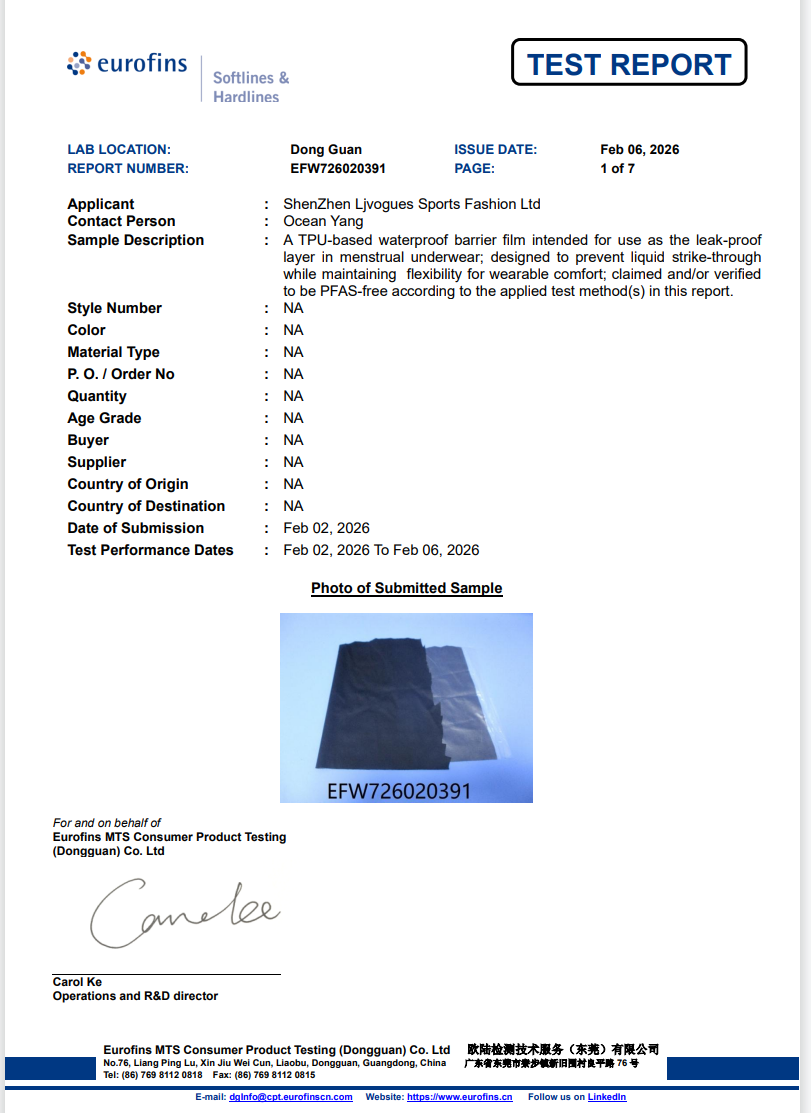
Supplier evaluation should therefore go beyond unit price. Ask how many period underwear styles the factory has developed, which internal tests it can perform, how size grading is handled, whether third-party laboratories are available, how waterproof materials are checked after washing, and how production tolerances are recorded. Also ask to review sample reports or anonymized QC documents where commercially possible.
A manufacturer that can answer with measurable information is easier to manage than one using broad claims. “The fabric shrank 2.8% after the specified wash procedure” is more useful than “the fabric has good stability.” “Three samples were tested at the same liquid volume” is more useful than “absorbency is excellent.” Product development becomes easier when materials, fit, absorbency, cost, and production quality are expressed in numbers that can be checked again on the next order.